Table Runner with Sage Green & Beige Maple Leaves and Burgundy Berries
Beginner Friendly
Perfect for those just starting their crochet journey, with clear instructions and simple techniques
Single-Day Project
A satisfying project you can complete in a single afternoon or evening.
Handmade Gift
A beautiful keepsake — free forever. Read online or print at home.
About This Table Runner with Sage Green & Beige Maple Leaves and Burgundy Berries
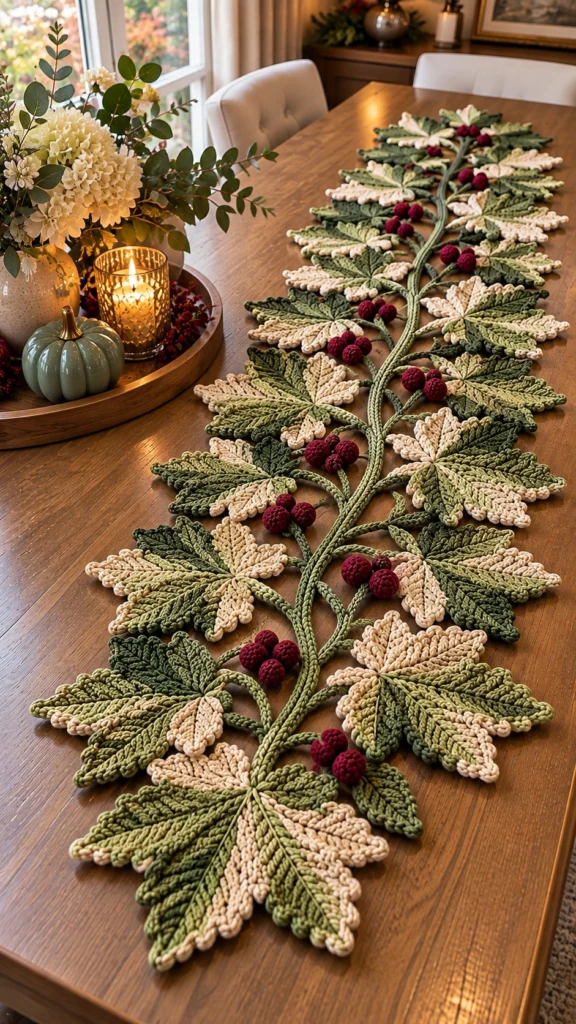
This crochet leaf table runner pattern builds a long, lace-like centerpiece from fourteen two-tone leaves, a rope-style vine and eight clusters of textured berries. Every leaf is made from five separate lobes worked in the round around a foundation chain, with the color changing along the center rib so each lobe is half sage or dark green and half cream. The lobes are sewn into a fan, and the leaves are then laid along the vine and stitched down.
The berries borrow from amigurumi construction. Each one is a small stuffed sphere that starts with six stitches in a magic ring and grows by six stitches a round, with puff stitches worked in offset rounds for a raspberry-like surface. The vine is a double slip-stitch cord that gives you the raised, rounded stem you see in the photo.
Plan on roughly 40 to 50 hours, spread over a few weeks. Most of that time goes into the 70 lobes, which are quick, repetitive and easy to carry around. The pattern suits crocheters who are comfortable with color changes mid-round, magic rings and sewing pieces together. Finish it before the holidays and it will sit on the table for years.
Materials
- DK cotton or cotton-blend yarn, sage green (SG) about 100 g
- DK cotton or cotton-blend yarn, dark green (DG) about 50 g
- DK cotton or cotton-blend yarn, cream (CR) about 60 g
- DK cotton or cotton-blend yarn, burgundy berry red (BB) about 25 g
- 3.0 mm crochet hook use a size smaller if your fabric feels floppy
- Polyester fiberfill a small handful for the berries
- Yarn needle
- Stitch markers 2
- Blocking mats and rustproof pins
- Spray starch optional, for a crisper finish
Abbreviations
chchainsl stslip stitchscsingle crochethdchalf double crochetinc2 sc in the same stitchdecsingle crochet 2 stitches together (invisible decrease preferred)MRmagic ringpuff(yarn over, insert hook, pull up a loop) 3 times in the same stitch, yarn over, pull through all 7 loops on the hookst(s)stitch(es)A / Bthe two colors of a lobe (see the colorways below)SG / DG / CR / BBsage green / dark green / cream / berry redColorways for the Leaves
Make 7 leaves in Colorway 1 and 7 leaves in Colorway 2. Alternating them along the vine gives the patchwork look of the photo. Each leaf uses 1 Large Lobe, 2 Medium Lobes and 2 Small Lobes.
- Colorway 1: Large Lobe A = SG, B = CR. Medium Lobes A = DG, B = SG. Small Lobes A = CR, B = SG.
- Colorway 2: Large Lobe A = DG, B = SG. Medium Lobes A = SG, B = CR. Small Lobes A = SG, B = DG.
Large Lobe (make 14)
- With A, ch 19. Rnd 1: 3 sc in the 2nd ch from hook (this is the tip), sc in the next 16 chs. Change to B on the last pull-through of the final sc. 3 sc in the last ch (this is the base), then sc in the 16 free loops back along the other side of the chain. Sl st to the first sc. (38 sc: 19 in A, 19 in B)
- Rnd 2: With A, sc in the first st, inc in the next st, sc in the next st (tip), sc in the next 16 sts. Change to B. Sc in the next st, inc in the next st, sc in the next st (base), sc in the next 16 sts. Sl st to the first sc. (40 sc: 20 in A, 20 in B)
- Rnd 3: With A, *sc in the next st, 2 hdc in the next st*, repeat 10 times (30 sts). Change to B and repeat *sc, 2 hdc in next st* 10 times (30 sts). Sl st to the first st and fasten off, leaving a 30 cm tail. (60 sts)
- Weave in the tail you did not leave for sewing. Block the lobe flat so the scallops sit evenly.
Medium Lobe (make 28)
- With A, ch 15. Rnd 1: 3 sc in the 2nd ch from hook (tip), sc in the next 12 chs. Change to B on the last pull-through of the final sc. 3 sc in the last ch (base), then sc in the 12 free loops back along the other side. Sl st to the first sc. (30 sc: 15 in A, 15 in B)
- Rnd 2: With A, sc in the first st, inc in the next st, sc in the next st (tip), sc in the next 12 sts. Change to B. Sc in the next st, inc in the next st, sc in the next st (base), sc in the next 12 sts. Sl st to the first sc. (32 sc: 16 in A, 16 in B)
- Rnd 3: With A, *sc in the next st, 2 hdc in the next st*, repeat 8 times (24 sts). Change to B and repeat *sc, 2 hdc in next st* 8 times (24 sts). Sl st to the first st and fasten off, leaving a 30 cm tail. (48 sts)
Small Lobe (make 28)
- With A, ch 11. Rnd 1: 3 sc in the 2nd ch from hook (tip), sc in the next 8 chs. Change to B on the last pull-through of the final sc. 3 sc in the last ch (base), then sc in the 8 free loops back along the other side. Sl st to the first sc. (22 sc: 11 in A, 11 in B)
- Rnd 2: With A, sc in the first st, inc in the next st, sc in the next st (tip), sc in the next 8 sts. Change to B. Sc in the next st, inc in the next st, sc in the next st (base), sc in the next 8 sts. Sl st to the first sc. (24 sc: 12 in A, 12 in B)
- Rnd 3: With A, *sc in the next st, 2 hdc in the next st*, repeat 6 times (18 sts). Change to B and repeat *sc, 2 hdc in next st* 6 times (18 sts). Sl st to the first st and fasten off, leaving a 30 cm tail. (36 sts)
Leaf Assembly (make 14)
- Lay the Large Lobe tip-up on a flat surface. Place a Medium Lobe on each side at roughly 45 degrees from the center, and a Small Lobe on each side pointing down and outward at roughly 135 degrees, so all five bases meet at one point.
- Turn every lobe so its A half faces the same direction (all A halves on the left of their own rib). This keeps the two-tone split flowing across the leaf.
- Overlap the base stitches by about 1 cm. Pin, then whip stitch the bases together with the yarn tails, passing through the 3 base stitches of each lobe.
- Where neighboring lobes touch along their edges, sew them together for about 3 cm up from the base. Leave the rest of each lobe free so the points stand out.
- Turn the leaf over and sew a Leaf Stem (below) to the base, covering the join.
Leaf Stem (make 14)
- With SG, ch 13.
- Sl st in the 2nd ch from hook and in each ch across. (12 sl st)
- Fasten off, leaving a 20 cm tail for sewing to the leaf base. Keep the starting tail for attaching to the vine.
Berries (make 24)
- With BB, 6 sc in MR. Place a marker in the first st and move it up each round. (6)
- Rnd 2: inc in each st around. (12)
- Rnd 3: *sc in the next st, inc in the next st*, repeat 6 times. (18)
- Rnd 4: *sc in the next 2 sts, puff in the next st*, repeat 6 times. (18)
- Rnd 5: sc in each st around. (18)
- Rnd 6: sc in the next st, *puff in the next st, sc in the next 2 sts*, repeat 5 times, puff in the next st, sc in the next st. This offsets the puffs from Rnd 4. (18)
- Rnd 7: *sc in the next st, dec*, repeat 6 times. (12) Stuff the berry firmly now.
- Rnd 8: dec 6 times. (6)
- Fasten off, leaving a 20 cm tail. Use the needle to close the hole through the front loops, then pull the tail inside or keep it for attaching to a stem.
Berry Stems (make 8)
- With SG, ch 16.
- Sl st in the 2nd ch from hook and in each ch across. (15 sl st)
- Fasten off, leaving a 25 cm tail. Sew 3 berries to the free end of the stem, close together, so they form one cluster. Sew the remaining stem end to the vine during assembly. This makes 8 clusters of 3 berries (24 berries in total).
Main Vine (make 1)
- With SG, ch 201.
- Pass 1: sl st in the 2nd ch from hook and in each ch across. (200 sl st) Keep the stitches slightly loose so the cord stays flexible.
- Pass 2: rotate the work to the opposite side of the chain and sl st in each free loop back along the chain, one sl st per loop (about 200 sl st). This second pass is what makes the cord round and raised.
- Sl st in the first ch of the foundation chain to finish the end neatly. Fasten off and weave in the ends.
- Steam the vine gently while shaping it into a loose S curve. It should keep that curve once it dries.
Finishing
Pin the vine in a gentle S curve on a blocking mat, about 110 cm long. Pin the leaves in place along the vine, alternating colorways and alternating left and right, with each leaf overlapping its neighbor by about a quarter. Sew each leaf stem to the vine first, then stitch the overlapping lobes to each other in two or three places so the runner behaves as one piece.
Sew the 8 berry clusters onto the vine between the leaves, with the stem ends hidden under a leaf lobe. Work with the runner on the mat the whole time so you can check the spacing before each stitch. When everything is sewn, steam block the whole runner, lightly spray with starch if you want crisp points, and let it dry completely before lifting it from the mat.
Tips for Success
- Swap colors on the last pull-through of the final stitch of each half, and carry the unused yarn loosely behind the work. Tight carrying puckers the lobe.
- Work into the free loops on the second side of the foundation chain with the same tension as the first side. An uneven lobe will not lie flat.
- Use the same hook for all 70 lobes. Changing hook sizes midway changes lobe size and makes the five lobes of a leaf hard to align.
- Block the lobes before sewing. Scalloped edges open up and become easy to match once pinned flat.
- Make the berries one color batch at a time and keep the stuffing amount consistent so all 24 look alike.
Common Mistakes to Avoid
- Joining the lobes with the A and B halves mixed up. Lay every leaf out dry and check the colors before sewing; unpicking whip stitch is slow.
- Miscounting the middle chains on the Large Lobe. Count 16 sc after the tip and again after the base, and the 38-stitch total will tell you immediately if you slipped.
- Stuffing the berries too lightly, which leaves puff stitches flat and floppy. Stuff until the berry feels firm like a small marble.
- Making the vine too tight. A tight cord curls and will not lie flat on the table; loosen your tension for the sl st passes.
- Sewing every lobe flat to its neighbor along the whole edge. The points should stay free so the leaf keeps its shape.
Ways to Customize This Pattern
- Make fewer leaves for a shorter table topper. Eight leaves and 4 berry clusters gives a runner about 70 cm long.
- Use autumn tones instead of sage and cream, such as rust, mustard and brown, for a harvest version.
- Make the berries in white or pale gold for a winter-themed runner.
- Add surface slip-stitch veins down the center of each lobe in a contrasting yarn for more definition.
- Make 4 extra leaves and use them as coasters by sewing the lobes tight together without a stem.
Frequently asked questions
Yes, but the lobes and the runner will come out larger, and the stitch counts do not change. Test one Large Lobe first and measure it. If it is more than about 14 cm long, move to a smaller hook or go back to DK.
Cotton holds a crisp edge and blocks well, so the scalloped lobes keep their shape on a table. A wool or acrylic version will work, but it will be softer and the leaf points may curl slightly.
Sewing the overlapping lobes to each other in two or three places makes the runner one connected piece, and a non-slip liner under it helps on glossy wood. Spray starch also stiffens the leaves slightly so they stay put.
Yes. Lengthen the vine by working a longer foundation chain (about 20 chs per 7 cm) and make extra leaves and berry clusters in the same proportion. Allow roughly one extra leaf for every 8 cm of added vine.
The finished Table Runner with Sage Green & Beige Maple Leaves and Burgundy Berries